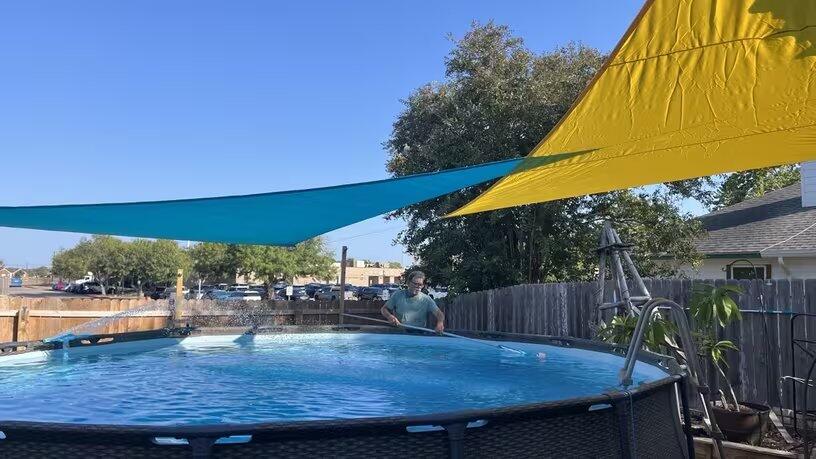
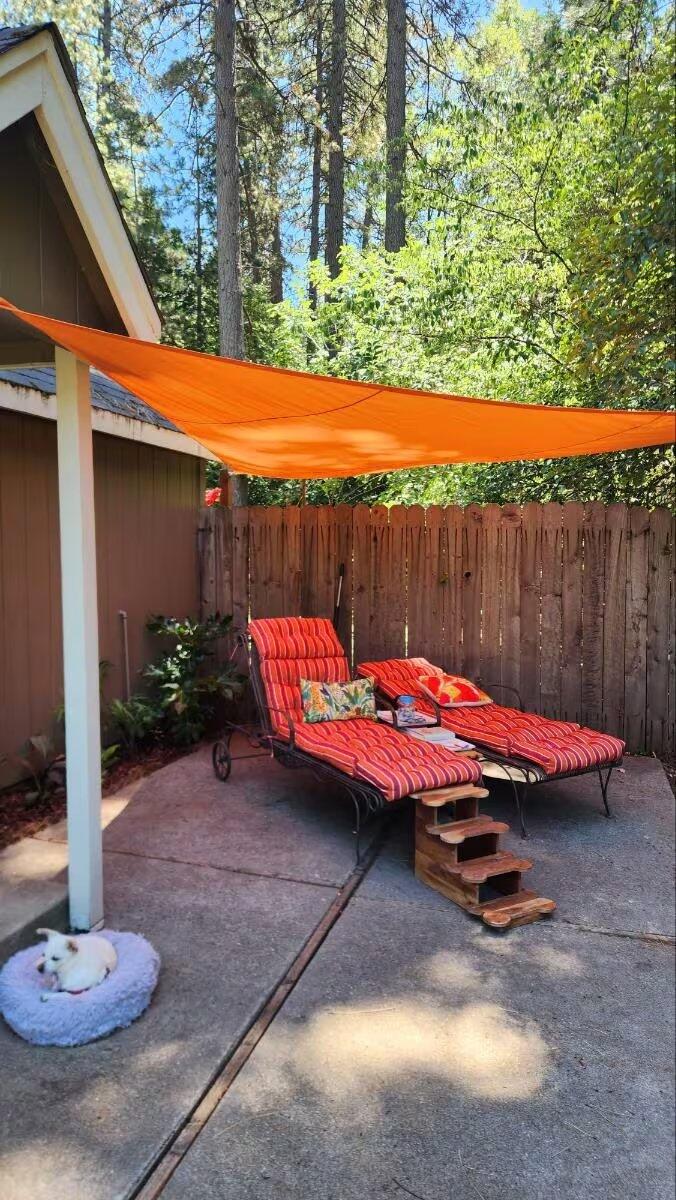
A shade sail is one of the easiest ways to shade a deck, but it only works if every corner is tied to something strong. A tensioned sail pulls hard on its anchor points, and the pull gets much stronger in wind. Deck boards, railings and gutters are not built for that. Here is where to anchor each corner instead.
Quick answer
- Never anchor a shade sail to deck boards, deck railings, balusters or gutters.
- Use solid structure: the house wall or fascia, posts set in concrete footings beside the deck, strong structural posts, or a concrete slab.
- Make the sail 1 to 3 ft smaller than the distance between anchor points on each side, so there is room for hardware and tension.
- Give it a slope so rain runs off, and take the sail down before storms.
Option 1: Mount to the house
If the deck is attached to the house, the wall is often your best high anchor point. Fix an eye pad or pad eye into solid structure, such as a rafter tail, beam or framing behind the fascia, not into siding or trim alone. A high corner on the house and lower corners out over the deck also gives you the slope you need for runoff. If you are not sure what is behind the wall, ask a contractor before drilling.
Option 2: Set posts in the ground beside the deck
For the outer corners, the most reliable choice is a post set in its own concrete footing in the yard next to the deck, not on the deck. Our 8 ft and 12 ft stainless steel poles come with a reinforced anchor frame for setting the post in a concrete footing, and a D-ring clamp that slides to any height on the pole. Our shade sail pole guide explains footings and pole heights.
Option 3: Use strong structural posts
Some decks and pergolas have large structural posts that run down to their own footings. These can work as anchor points, but only if they are built for it. Thin railing posts are not. When in doubt, have a contractor check the post and footing before you hang a sail from it.
Option 4: Concrete patio or pool deck
If your "deck" is a concrete patio or pool deck, a post with a base plate can bolt straight onto solid concrete. The 8 ft freestanding shade sail post has a 7.75 x 7.75 in. stainless base plate for exactly this. A wood deck is a different story: the base plate is made for solid concrete, not wood decking.
Size the sail to fit your anchor points
Measure the distance between your anchor points, then subtract 1 to 3 ft from each side for the hardware. For example, anchor points 14 ft by 18 ft apart fit a 12 x 16 ft sail. See what size shade sail you need for more examples, or browse all shade sails.
Angle it so it sheds water
Set at least one corner noticeably higher than the others. A twisted, sloped sail looks better and keeps rain from pooling. This matters most with a waterproof sail, which should be installed with a 20 to 40 degree slope. Our guide on how to angle a shade sail shows the common layouts.
Hardware you need
- A hardware kit with pad eyes, turnbuckles and snap hooks for each corner. See our shade sail hardware kits.
- Turnbuckles to pull the sail tight after it is hung.
- Cable or extra length if a corner falls short of its anchor point.
The shade sail hardware guide explains what each piece does.
Frequently asked questions
Can I attach a shade sail to my deck railing?
No. Railings are built to stop people from falling, not to resist the constant pull of a tensioned sail in wind. Use the house, a post in its own footing or a concrete slab instead.
Can I bolt a shade sail pole onto a wood deck?
Our pole base plates are made to bolt onto solid concrete. For a wood deck, set the post in a concrete footing in the ground beside the deck.
What about windy sites?
Use stronger anchor points, a heavy duty sail and take the sail down before storms. See shade sails for windy areas.